
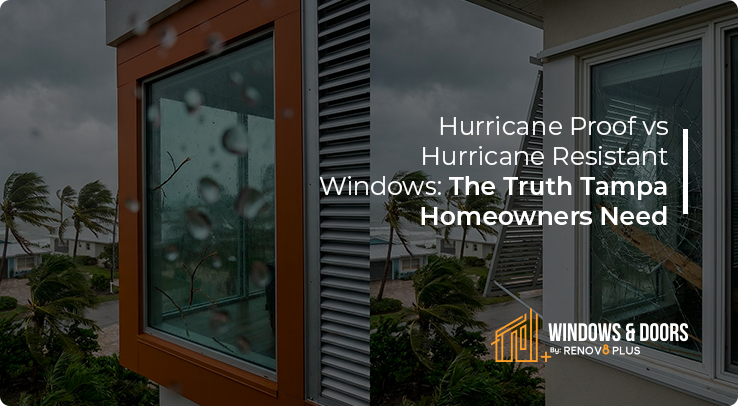
Hurricane Proof vs Hurricane Resistant Windows: The Truth Tampa Homeowners Need
On this page
Listen, if you’re shopping for storm windows in Tampa Bay and you’re confused by the terminology you’re not alone. The industry throws around terms like “hurricane-proof,” “hurricane-resistant,” and “impact-rated” like they’re interchangeable. They’re not. And understanding the difference could mean the gap between protecting your family and facing a devastating insurance claim denial.
Here’s the straight truth: No window is truly hurricane-proof. But the right hurricane-resistant windows? They’re tested to withstand forces that would make most structures crumble. Let’s cut through the marketing fluff and talk facts.
Hurricane-Proof Windows: Do They Exist?
Let’s get this out of the way first: “hurricane-proof” is a marketing term, not a technical specification. And frankly, it’s misleading.
Here’s why no window can be 100% “proof” against hurricanes: Physics doesn’t work that way. A Category 5 hurricane generates wind speeds exceeding 157 mph, creating pressures that can reach 98+ pounds per square foot (PSF). When you combine those sustained winds with flying debris think 2×4 lumber becoming missiles at 50 feet per second there’s always a theoretical breaking point Hurricane Impact Rating Guide.
When manufacturers use “hurricane-proof,” what they really mean is “hurricane-resistant” or “impact-resistant.” The distinction matters for your insurance coverage. Florida insurance companies won’t honor policies based on marketing promises they require specific certifications and test results.
The reality? Modern impact windows are engineered to withstand extreme conditions that would destroy standard windows. But calling them “proof” creates false expectations and legal liability issues, which is why reputable manufacturers (like the products Renov8 Plus installs) use accurate terminology: hurricane impact-resistant windows.
Hurricane-Resistant Windows Explained
The proper industry term is “Hurricane Impact-Resistant Windows”and there’s a reason for the precision. These windows undergo rigorous testing to meet or exceed standards set by ASTM International (American Society for Testing and Materials).
Two critical standards define hurricane-resistant windows:
- ASTM E1886: This test method establishes how products are tested for impact resistance and cyclic pressure loading
- ASTM E1996: This specification defines the performance requirements and impact resistance levels (categorized A through E)
Hurricane-resistant windows are specifically engineered to do three things during a storm:
- Resist penetration from windborne debris (both large and small projectiles)
- Maintain structural integrity under extreme pressure (positive and negative wind load.
- Prevent catastrophic failure that would allow wind and rain to enter your home.
What makes them “resistant” rather than “proof”? They’re designed to withstand specified conditions based on your geographic wind zone. Windows rated for Tampa’s coastal areas (Wind Zone 4) undergo different testing than those for inland regions Understanding Impact Window Ratings.
Here’s what matters for Tampa homeowners: Your windows must be approved by Florida Product Approval (FPA) and ideally carry Miami-Dade County NOA (Notice of Acceptance)—the gold standard we’ll discuss shortly.
Impact-Rated Windows: The Gold Standard
Impact-rated windows represent the highest tier of hurricane protection available. Here’s what separates them from standard “hurricane-resistant” claims:
Design Pressure (DP) Ratings
Your window’s DP rating tells you the maximum wind pressure it can withstand without failure. This is measured in pounds per square foot (PSF):
- DP 15-30: Suitable for inland areas with lower wind exposure (77-89 mph winds)
- DP 30-50: Recommended for coastal zones like Tampa Bay (89-114 mph winds)
- DP 50+: Required for high-exposure coastal properties (Category 3+ protection)
For Tampa Bay homeowners, we typically install windows with DP ratings of 40-60 depending on your property’s specific location and exposure How Impact-Resistant Windows Are Rated.
Large Missile Impact Test
This is the showpiece test: A 9-pound 2×4 lumber projectile launched at 50 feet per second directly at the window. The glass must:
- Absorb the impact without creating an opening
- Remain anchored in the frame
- Maintain a protective barrier against wind and water
That’s equivalent to a flying piece of lumber hitting your window at 34 mph the kind of debris that becomes deadly during hurricanes.
Small Missile Impact Test
Windows face 10 consecutive shots of 2-gram steel ball bearings fired at 130 feet per second at different points. This simulates gravel, roof tiles, and smaller debris that become shrapnel during storms ASTM E1996 Missile Levels.
Cyclic Pressure Testing
After surviving the missile impacts, windows undergo 9,000 cycles of positive and negative pressure simulating the punishing, repetitive force of sustained hurricane winds buffeting your home for hours. This tests whether the window will fatigue and fail during an extended storm.
Bottom line: Impact-rated windows don’t just survive one hit they’re engineered to protect your home through the entire duration of a major hurricane.
How Much Force Can Hurricane Impact Windows Take?
Let’s translate those test specs into real-world scenarios you faced recently in Tampa Bay.
Hurricane Categories & Wind Force
Here’s what impact windows are built to withstand:
|
Category |
Wind Speed (mph) |
Pressure (PSF) |
|
Category 1 |
74-95 |
22-36 |
|
Category 2 |
96-110 |
37-48 |
|
Category 3 |
111-129 |
49-66 |
|
Category 4 |
130-156 |
67-97 |
|
Category 5 |
157+ |
98+ |
Here’s the critical insight: Wind force increases exponentially not linearly. A Category 4 hurricane generates roughly 5 times more force than a Category 1. That’s why proper DP ratings matter so much Wind Load Calculations.
Tampa Bay Hurricane History: Real-World Testing
Let’s talk about what Tampa Bay homeowners faced in 2024 the year we’d all rather forget:
Hurricane Helene (September 2024):
- Made landfall 100+ miles north but devastated Tampa Bay with storm surge
- Peak winds: 140 mph at landfall (Category 4)
- Tampa Bay experienced sustained winds of 70-90 mph with gusts over 100 mph
- Record storm surge: 6-8 feet in many coastal neighborhoods
Hurricane Milton (October 2024):
- Made landfall near Siesta Key as Category 3 with 115 mph winds
- Just 13 days after Helene
- Tampa Bay wind gusts may have reached 100+ mph
- Caused catastrophic damage to structures without proper protection
- Tropicana Field’s fabric roof was shredded—and that’s a commercial structure
The verdict? Homes with properly installed impact-rated windows overwhelmingly survived with minimal interior damage. Homes with standard windows or improperly installed “hurricane” windows faced catastrophic breaches 2024 Hurricane Season Review.
Here’s a sobering fact: Tampa Bay hasn’t had a direct Category 3+ hit since 1921—over 100 years ago. Experts widely consider Tampa Bay “overdue” for a major hurricane. When that storm finally arrives, the difference between impact-rated and standard windows won’t be theoretical it’ll be catastrophic.
Testing Standards: What Your Windows Need to Pass
Not all “certified” windows are created equal. Here are the certifications that actually matter in Florida:
Miami-Dade County NOA (Notice of Acceptance)
This is the gold standard for hurricane protection. Miami-Dade County maintains the strictest building codes in the nation due to lessons learned from Hurricane Andrew in 1992 $31 billion in damages adjusted for inflation.
Miami-Dade NOA certification means your windows passed:
- TAS 201, 202, 203 large missile impact protocols
- Cyclic pressure testing beyond ASTM requirements
- Water resistance testing under extreme conditions
- Quality control and manufacturing oversight
Why it matters even if you’re not in Miami: If a window can survive Miami-Dade’s High-Velocity Hurricane Zone (HVHZ) requirements, it can absolutely protect your Tampa home.
Florida Product Approval (FPA)
All windows installed in Florida must have an FPA number to pass building inspection. This state-level approval ensures products meet Florida Building Code (FBC) requirements for your specific wind zone Florida Product Approval Database.
Red flag: If your contractor can’t provide the FPA number before installation, walk away. No FPA = failed inspection = wasted money.
AAMA Gold Label Certification
The American Architectural Manufacturers Association (AAMA) Gold Label certifies that windows meet the highest standards for:
- Air infiltration resistance
- Water penetration resistance
- Structural performance under wind loads
- Forced-entry resistance
This certification requires ongoing third-party quality audits not just one-time testing AAMA Certification Overview.
At Renov8 Plus, every window we install carries Miami-Dade NOA approval, Florida Product Approval, and AAMA Gold Label certification. We don’t cut corners because we know what’s at stake when the next storm hits.
Hurricane Window Strength: Materials Matter
Here’s where the rubber meets the road or rather, where the glass meets the Category 5 winds. The materials in your impact windows determine whether they’ll protect your family or fail when you need them most.
Glass Types
Laminated Glass is the backbone of all impact-resistant windows. It consists of two panes of glass bonded to a plastic interlayer (more on that in a moment). When struck, the glass may crack—but it stays adhered to the interlayer, maintaining a protective barrier.
Tempered Glass is sometimes used for the outer pane. It’s heat-treated to be 4-5 times stronger than standard annealed glass. When it breaks, it crumbles into small, relatively harmless pieces but that’s not enough for hurricane protection by itself.
Heat-Strengthened Glass offers a middle ground: stronger than annealed but more flexible than fully tempered glass, reducing the risk of spontaneous breakage while maintaining impact resistance.
Interlayer Technology: PVB vs SGP
This is where manufacturers separate themselves. The plastic interlayer between glass panes determines how well your window performs under extreme stress.
PVB (Polyvinyl Butyral):
- Standard interlayer found in most impact windows
- Provides solid impact resistance for residential applications
- More flexible and cost-effective
- Adequate for most Tampa Bay installations
- Works well in double-pane configurations for energy efficiency
SGP (SentryGlas® Ionoplast):
- Premium interlayer offering superior performance
- 5 times stronger and 100 times stiffer than PVB
- Maintains structural integrity even after glass fractures
- Better post-breakage performance (glass stays in opening, not sagging)
- Ideal for larger windows and high-exposure coastal properties
- Clearer view (less yellowing over time)
Real talk: For most Tampa homeowners, quality PVB laminated glass provides excellent protection. We recommend SGP upgrades for:
- Large picture windows (6+ feet wide)
- Properties within 1 mile of coastline
- Homes in surge zones
- Homeowners who want absolute maximum protection
Technical Comparison: PVB vs SGP
Frame Materials
The strongest glass in the world won’t help if the frame fails. Here’s what works in Florida:
Aluminum Frames:
- Excellent structural strength
- Won’t warp, rot, or deteriorate in Florida humidity
- Superior anchoring capabilities for high DP ratings
- Thermal breaks prevent heat transfer
Vinyl Frames:
- Good impact resistance with reinforced chambers
- Energy efficient
- Low maintenance
- Limited to lower DP ratings in extreme sizes
Hybrid Systems:
- Aluminum exterior for strength
- Vinyl interior for energy efficiency
- Best of both worlds for premium installations
Renov8 Plus Materials Breakdown
We install impact windows with:
- Laminated glass with PVB or SGP interlayers (based on your needs and budget)
- Aluminum frames with multi-point locking systems
- Stainless steel anchoring hardware (corrosion-resistant in salt air)
- Marine-grade sealants designed for Florida’s climate
- Full perimeter structural silicone for maximum water resistance
Every component is tested as a complete system because a window is only as strong as its weakest link.
Can Hurricane Windows Fail? (Honest Answer)
Let’s be brutally honest: Yes, hurricane windows can fail. But here’s what you need to know 80% of impact window failures are caused by improper installation, not product defects Hurricane Wind Micro-zones and Window Failures.
Installation Quality: The Make-or-Break Factor
The most common failure points:
Improper Anchoring:
- Insufficient fasteners or wrong fastener type
- Fasteners not reaching structural framing
- Inadequate spacing (should be 12-16 inches maximum)
- Using drywall screws instead of structural fasteners
Poor Frame Attachment:
- Gaps between frame and rough opening
- Missing structural sealant
- Inadequate shimming leading to frame flex
- Water infiltration paths that compromise structural integrity
Old vs. New Building Codes:
Tampa’s building codes have evolved dramatically since Hurricane Andrew (1992). If your home was built before 2002, it likely doesn’t meet current standards for:
- Wind load resistance
- Structural connections
- Opening protection requirements
This is why we refuse to use subcontractors at Renov8 Plus. Our in-house installation crews:
- Are factory-trained on every product we install
- Follow manufacturer specifications to the letter
- Use only approved fastening systems
- Document every installation for permit compliance
- Understand Tampa Bay’s specific building codes and enforcement
Red Flags That Indicate Poor Installation
Watch for these warning signs:
- Visible gaps between frame and wall
- Windows that don’t operate smoothly
- Air or water leaks around frames
- Contractor can’t provide Miami-Dade NOA or FPA documentation
- “We don’t need permits” (RUN—this is illegal in Florida)
- Crew shows up without proper tools or materials
- Installation completed in unreasonably short time
Bottom line: The quality of installation matters more than the brand of window. A premium window installed improperly will fail. A good window installed correctly will protect your home for decades.
Tampa Bay Hurricane Risk: What You’re Up Against
Let me paint you a picture that should make every Tampa homeowner pay attention.
Historical Hurricane Data
Tampa Bay holds a unique and concerning distinction: We haven’t had a direct hit from a major hurricane in over 100 years since the 1921 Tampa Bay Hurricane. That storm caused catastrophic damage with a 10-11 foot storm surge that reached into downtown Tampa.
Here’s why that century-long gap is terrifying, not comforting:
The Tampa Bay area is vastly more developed and populated than in 1921:
- Population then: ~51,000 in Tampa
- Population now: 3.3+ million in the Tampa Bay metro area
- Property values: Hundreds of billions of dollars in coastal real estate
- Infrastructure: International airport, seaport, hospitals, power grid all vulnerable
Storm Surge Zones: Know Your Risk
Tampa Bay’s geography makes it uniquely vulnerable to storm surge. The shallow, gently sloping Gulf of Mexico floor acts like a funnel, amplifying surge heights.
Storm surge projections for Tampa Bay (Category 3+ direct hit):
- Downtown Tampa: 15-20+ feet
- South Tampa, Davis Islands: 12-18 feet
- St. Petersburg waterfront: 10-15 feet
- Clearwater Beach: 12-16 feet
- Apollo Beach, Ruskin: 15-20+ feet
A 2010 Tampa Bay Regional Planning Council study modeled a “Hurricane Phoenix” scenario—a Category 5 hitting downtown Tampa with 160 mph winds. The projection: 2,000 deaths and $250 billion in damage Tampa Bay Catastrophic Hurricane Scenarios.
Why Tampa is “Overdue” for a Direct Hit
Statistically, Tampa Bay sits in a high-risk hurricane zone with a 1 in 20 chance annually of a major hurricane strike. After 100+ years without a direct hit, we’re playing Russian roulette every hurricane season.
The 2024 season showed us what near-misses can do Helene and Milton caused billions in damage without directly hitting Tampa. When the direct hit finally comes, homes without proper protection will face catastrophic damage.
2025 Hurricane Season Predictions
The 2025 Atlantic hurricane season forecast calls for:
- 13-19 named storms (above normal)
- 6-10 hurricanes
- 3-5 major hurricanes (Category 3+)
Colorado State University and NOAA both project an active season driven by warm Gulf of Mexico temperatures and favorable atmospheric conditions 2025 Hurricane Season Outlook.
Here’s the bottom line: If you don’t have impact-rated windows yet, you’re gambling with your family’s safety and your financial security. The next storm could be the one.
Real Tampa Homeowner Results: Impact Window Performance
Let’s talk about what actually happened to Tampa Bay homes during the 2024 hurricane season because real-world performance beats lab testing every time.
Hurricane Helene: The Storm Surge Event (September 26, 2024)
Homes WITH Impact Windows:
- Minimal to no interior water damage from window breaches
- Glass remained intact despite sustained 70-90 mph winds
- No debris penetration through windows
- Families able to shelter in place safely
- Quick return to normal after power restoration
Homes WITHOUT Impact Windows:
- Catastrophic breaches when standard windows failed
- Storm surge entered through broken windows, destroying interiors
- Wind-driven rain caused extensive damage even before surge arrived
- Total losses in many coastal properties
- Months of displacement for repairs
One customer in Apollo Beach (a Renov8 Plus installation from 2023) reported: “We watched our neighbor’s windows blow out during Helene. Ours didn’t even crack. We had zero interior damage while their house was destroyed. Best investment we ever made.”
Hurricane Milton: The Wind Event (October 9, 2024)
Milton made landfall as a Category 3 just south of Tampa Bay, with wind gusts in the metro area likely exceeding 100 mph including damage to Tropicana Field’s engineered fabric roof.
Homes WITH Impact Windows:
- Windows remained intact through sustained Category 2+ winds
- No projectile penetration despite significant airborne debris
- Maintained protective envelope of home
- Prevented pressure differentials that cause roof failures
Homes WITHOUT Impact Windows:
- Standard windows shattered from debris impact
- Sudden pressure changes contributed to roof damage
- Interior destruction from wind-driven rain
- Complete loss of contents in many cases
Insurance claim data (when disclosed) showed homes with properly installed impact windows filed claims averaging 85-90% lower than comparable homes with standard windows or storm shutters that weren’t deployed Hurricane Milton One Year Later.
The Investment vs. The Loss
Consider this real scenario:
Average Renov8 Plus impact window installation: $15,000-$30,000 (whole house)
Average insurance claim for home without impact windows (Helene/Milton): $75,000-$250,000+
Average increase in insurance premium without impact protection: $2,000-$5,000 annually
ROI becomes pretty clear: One storm pays for your impact windows multiple times over not to mention the peace of mind and safety you can’t put a price on.
Beyond Hurricane Protection: Additional Benefits
Here’s the thing most contractors won’t tell you: Hurricane windows aren’t just for hurricanes. The benefits extend to everyday life in ways that immediately improve your quality of living.
Security: Break-In Resistance
Those same laminated glass layers that stop 2×4 lumber at 50 feet per second also stop criminals cold. Impact windows require sustained, loud, repeated strikes to breach giving alarm systems time to activate and deterring most burglars who want quiet, quick entry.
FBI statistics show:
- 34% of burglars enter through front windows
- 23% through back windows
- Impact windows increase break-in time from 30 seconds to 3+ minutes
- Most burglars abandon attempts within 60 seconds of detection
Tampa homeowners report feeling safer at night, especially in ground-level bedrooms. One Renov8 Plus customer in South Tampa shared: We used to worry every time we traveled. Now we know our house is locked down like
Hand-picked articles for you
Ready to Transform Your Home?
Get your free quote within 24 hours and discover why Florida
homeowners trust Windows Defence.